
TL;DR
The short version: write plain, short English, decide who is reading before you translate, then check the greeting, every "you" and the sign-off by hand. AI translation gives you a fast first draft. It is never the finished email.
Arabic Business Email Without the Gender and Register Traps
Arabic makes you commit to the reader's gender and level of formality in every sentence, so a translated email is only as good as what you tell the tool first.
The short version: write plain, short English, decide who is reading before you translate, then check the greeting, every "you" and the sign-off by hand. AI translation gives you a fast first draft. It is never the finished email.
English lets you write "Can you send the file by Thursday?" without deciding anything about the reader. Arabic does not. The verb, the word for "you" and even your own adjectives change with gender, and the formality changes with the words you pick. A translation tool will often make those choices for you without saying so. The greeting is where gender, formality and relationship all show up at once, so that is where most of the work is.
Gender shows up in three places
Gender is built into Arabic verbs, adjectives and titles. In a normal business email it shows up in three places: the reader, you, and the people you mention.
| What you want to say | Masculine | Feminine |
|---|---|---|
| Can you...? (depends on the reader) | هل تستطيع | هل تستطيعين |
| I am happy (depends on the writer) | أنا سعيد | أنا سعيدة |
| Manager (depends on the person) | مدير | مديرة |
| Mr. / Ms. (depends on the person) | السيد | السيدة |
Start with the reader. If you write "Dear Dr. Sam," the tool cannot know whether Sam is a man or a woman, and machine translation has a well-documented habit of falling back to masculine forms when the source does not say. Check the name, ask a colleague, or rewrite the sentence so it does not address one person directly. A polite request such as نرجو إرسال الملف ("we kindly ask that the file be sent") does the job.
Then there is you. Your own adjectives agree with your gender, so a woman writes سعيدة where a man writes سعيد. Many writers sidestep the choice with يسعدني ("it pleases me"), as in يسعدني أن أتواصل معكم ("I am pleased to get in touch with you").
Last, titles and job names. Check them every time. One wrong ending can turn a female manager into a male one.
Register: formal on the page, human in the tone
Arabic has two layers. Modern Standard Arabic is the formal written language shared across the Arab world. Spoken dialects, such as Egyptian, Gulf, Levantine and Maghrebi, differ from it and from each other. Translation tools typically write Modern Standard Arabic, and for email that is the right default.
The trap is mixing registers. A casual "Hey team, quick one" translated word for word reads oddly in formal Arabic. A stiff reply to a friendly supplier can read as cold. Pick the tone before you translate and hold it to the end.
Formal Arabic email has a shape you can copy. Open with a greeting such as تحية طيبة. Make your point in the next sentence. In formal writing, the plural "you" (the ـكم ending) is a courteous way to address one person or a company, so a tool that talks to your client in the singular can sound too familiar. Close with مع خالص التحية والتقدير ("with sincere regards and appreciation").
Two more habits help. Drop idioms: "let's circle back" and "touch base" turn into nonsense when translated literally, so say what you mean. And write dates with the weekday and the month as a word, because calendars and working weeks are not the same in every country.
A workflow that catches most mistakes
- Write the English plainly. Instead of "Hi team, can we circle back on this by EOD?", write "Dear Ms. Hana, please send the signed contract by Thursday at 5 p.m. Thank you." The rewrite has a title that signals gender, one request and one deadline.
- Run it through the English to Arabic translator.
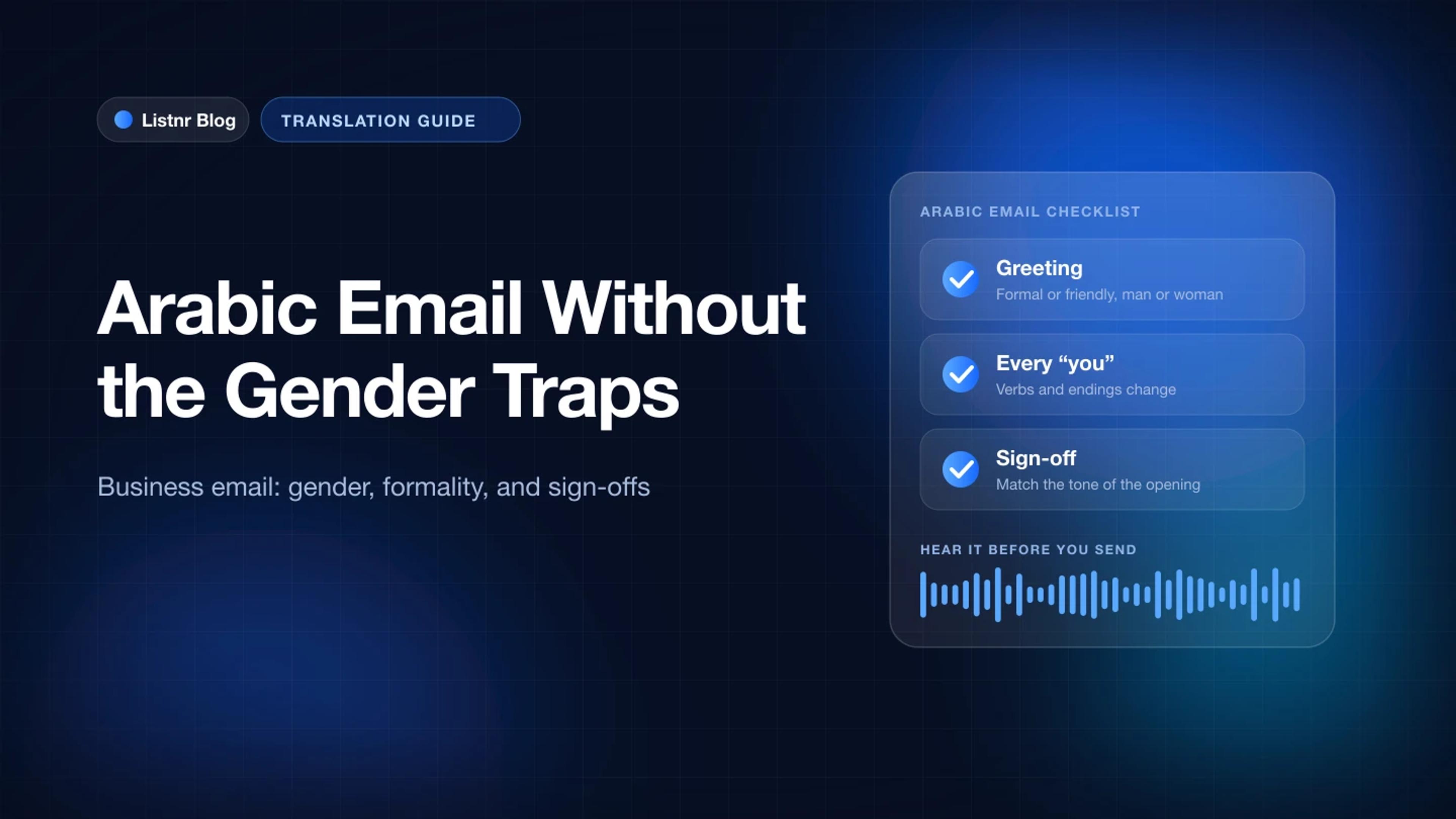
- Fix the three danger zones by hand: the greeting, every "you", and the sign-off.
- Translate the Arabic back into English and compare it with your original. If the meaning drifted, simplify the English and run it again.
- Have a native speaker read anything with money, dates or legal weight.
If you cannot read Arabic yourself, steps 4 and 5 are not optional. You are the one person who cannot check the output.
The same habit works in reverse. When a reply arrives, paste it into Arabic to English to get the gist, then check the numbers and dates against the original. Some teams mix Arabic, English and Urdu speakers. If a colleague reads Urdu more comfortably than English, Arabic to Urdu gives them the same message in their own language.
One formatting warning. Arabic runs right to left, and mixing it with English names, numbers or links can scramble punctuation. Send a test to yourself and read it on a phone before it goes to a client.
FAQs
Does AI translation default to the masculine in Arabic?
It can. Machine translation has a documented masculine default when the English does not say who is meant. Know who the reader is, check every "you", and rephrase a sentence if you cannot tell.
Should I write business email in Modern Standard Arabic or a dialect?
Modern Standard Arabic with a polite opener and closer is the safe default. Keep dialect for friendly chat with people you already know, and only if you are confident in it.
Can I use AI translation for a contract?
Use it to understand a draft or to prepare your own. For a contract, a tender or any document an authority will read, get an official or certified translation.
How do I handle names?
Keep names exactly as the person writes them. Ask how a name is spelled in Arabic script, and check the title that goes with it.
Translate the email, then hear it with Listnr
Once the Arabic reads right, you can listen to it. Translate the text first, then paste it into Listnr's Arabic text to speech page, pick a voice and preview the audio. Listnr has 1,000+ voices across 142+ languages. A short voice note or a meeting announcement sometimes lands better than a long email, and listening is a quick way to catch phrasing that sounds off.
AI translation is a first draft. Anything you submit to an authority, a court or a tender needs an official or certified translation.
Frequently asked questions
Does AI translation default to the masculine in Arabic?
It can. Machine translation has a documented masculine default when the English does not say who is meant. Know who the reader is, check every "you", and rephrase a sentence if you cannot tell.
Should I write business email in Modern Standard Arabic or a dialect?
Modern Standard Arabic with a polite opener and closer is the safe default. Keep dialect for friendly chat with people you already know, and only if you are confident in it.
Can I use AI translation for a contract?
Use it to understand a draft or to prepare your own. For a contract, a tender or any document an authority will read, get an official or certified translation.
How do I handle names?
Keep names exactly as the person writes them. Ask how a name is spelled in Arabic script, and check the title that goes with it.
Sources
Listnr · Primary workflow tool for creating the first Arabic draft from plain English.
Listnr · Useful for back-translation and checking whether the Arabic draft still says what the English intended.
Encyclopaedia Britannica · Neutral background on Arabic as a major Semitic language with formal and regional varieties.
W3C Internationalization · Reference for directionality issues when Arabic is mixed with English names, numbers, links, and punctuation.
arXiv · Research background on gender defaults and bias patterns in machine translation.
About Listnr Team
Listnr Team writes and curates content for the Listnr editorial workflow.