
TL;DR
This guide compares the 10 best AI customer support tools by what they actually do well, who they are built for, and what they cost to start.
10 Best AI Customer Support Tools: Helpdesks, AI Agents, and Voice
Almost every support platform now says it has AI. Some of them can genuinely resolve a customer's problem from start to finish: look up the order, check the refund policy, issue the refund, and close the ticket. Others draft a reply and wait for a human to click send. Both are useful, but they solve very different problems, and the marketing rarely makes the difference clear.
This guide compares the 10 best AI customer support tools by what they actually do well, who they are built for, and what they cost to start. It also covers the part of support most AI roundups skip: the voice your customers hear on the phone, in your phone menu, and in your help videos.
Quick Comparison
| Tool | Best for | AI focus | Starting price* |
|---|---|---|---|
| Freshdesk (Freddy AI) | All-in-one helpdesk for growing teams | Reply drafts, routing, self-service | About $18/agent/month |
| Intercom Fin | SaaS and chat-first teams | Autonomous AI agent | About $0.99 per resolution, plus seats |
| Zendesk AI | Teams already on Zendesk | Agent copilot, routing, intent detection | About $25/agent/month, AI add-ons extra |
| Gorgias | Shopify and ecommerce stores | Order-aware AI agent | About $10/month for 50 tickets |
| Ada | Enterprise self-service | No-code AI agent, 50+ languages | Custom |
| Tidio (Lyro) | Small businesses and stores | Chat AI agent from help content | About $24/month |
| Help Scout | Small email-first teams | AI drafts, summaries, answers | About $55/month |
| Forethought | Enterprise teams on Salesforce | Resolution, triage, agent assist | Custom |
| Zoho Desk (Zia) | Budget teams using Zoho | Sentiment, predictions, answer bot | About $7/user/month |
| Listnr | The voice layer: phone menus, IVR, help audio and video | Realistic multilingual AI voices and API | $19/month |
*Prices are starting prices published by each vendor at the time of writing. They change often, and AI features are frequently billed as add-ons, so confirm on the vendor's pricing page.
AI Chatbot vs. AI Agent: What Actually Matters
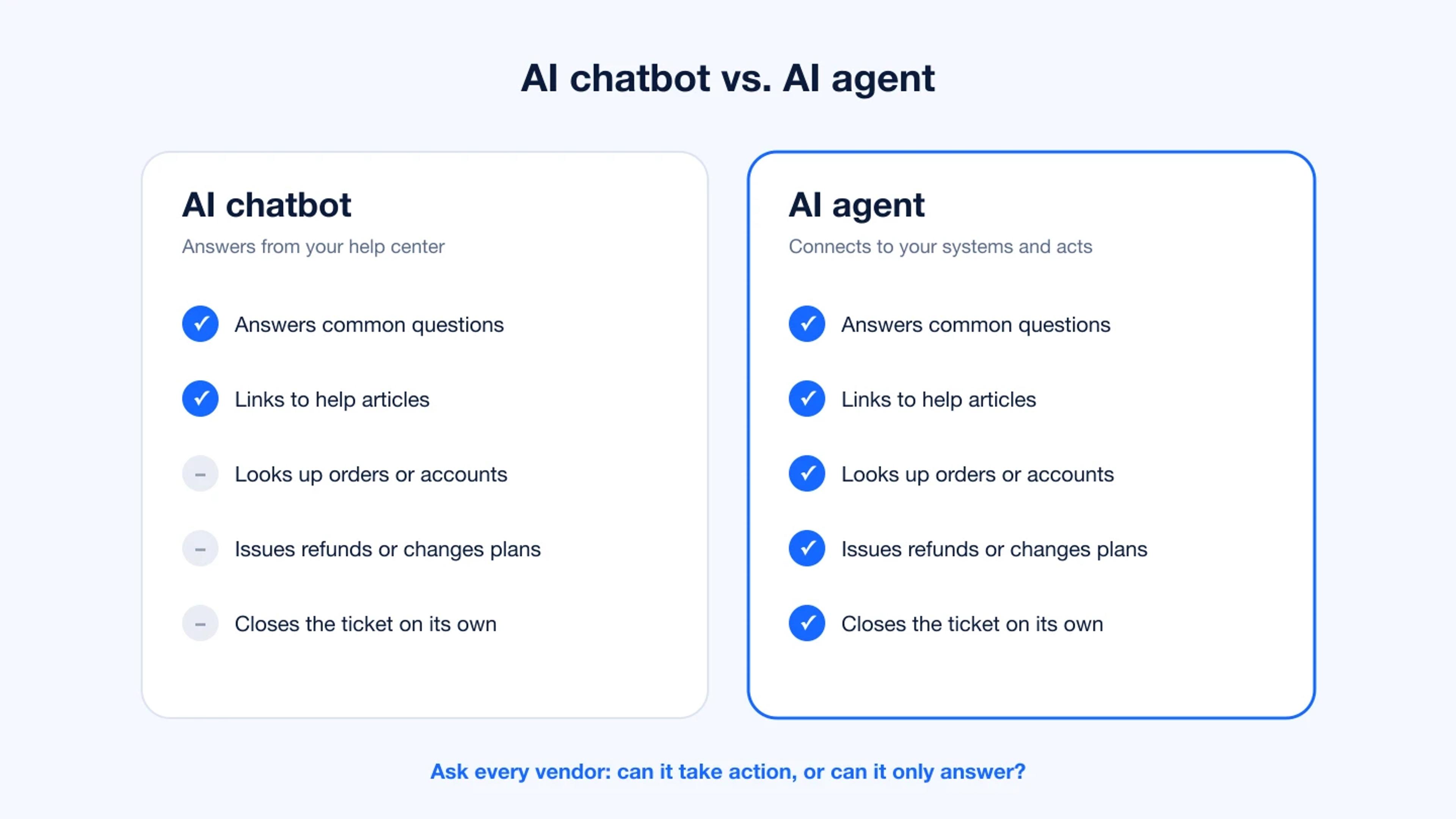
The single most useful question to ask any vendor is: can it take action, or can it only answer?
An AI chatbot answers questions from your help center. It is good at "What are your opening hours?" and "How do I reset my password?" It hands off as soon as the customer needs something done.
An AI agent connects to your systems. It can look up an order, check a policy, change a subscription, process a return, or update a record inside one conversation. That is what moves the resolution rate.
When a vendor quotes a resolution rate, ask how they define it. Some count any conversation where the customer did not ask for a human. Others only count conversations where the problem was confirmed as solved. The numbers are not comparable across vendors, so the only reliable figure is the one you measure in your own trial.
The 10 Best AI Customer Support Tools
1. Freshdesk (Freddy AI)
Best for: growing teams that want one helpdesk for email, chat, phone, and social.
Freshdesk brings every channel into one workspace, and Freddy AI adds reply drafting, automatic tagging and routing, suggested help articles, and self-service bots. It is approachable for teams that are new to AI and has a large app marketplace.
Pros: one workspace for all channels, easy to start, real-time reporting.
Cons: multilingual support and advanced automation sit on higher tiers, and some integrations take real setup work.
2. Intercom Fin
Best for: SaaS companies and chat-first support teams.
Fin is an autonomous AI agent that answers and resolves conversations across chat, email, and other channels, with tools for testing answers before they go live. Its per-resolution pricing suits teams with uneven volume.
Pros: strong answer quality, smooth handoff to human agents with full history, pricing tied to outcomes.
Cons: seat costs add up on top of resolutions, and ticket workflow customization is more limited than traditional helpdesks.
3. Zendesk AI
Best for: teams already running on Zendesk.
Zendesk adds an agent copilot, intelligent routing, intent and sentiment detection, generative reply suggestions, and AI agents on top of its mature ticketing platform.
Pros: proven at scale, a huge app marketplace, copilot features that speed up agents.
Cons: advanced AI is priced per seat as an add-on, which gets expensive, and the product can feel spread across many modules.
4. Gorgias
Best for: Shopify and ecommerce brands.
Gorgias is built around order data. Its AI agent can check order status, process returns and cancellations, and answer shipping questions using live store data, all from a unified inbox.
Pros: resolves order questions end to end, deep Shopify and WooCommerce integration.
Cons: built for retail, so less suited to other industries, and ticket-based pricing climbs with volume.
5. Ada
Best for: large companies automating high-volume self-service.
Ada provides a no-code AI agent with authentication, personalization by customer segment, proactive messaging, and support for 50+ languages.
Pros: strong language coverage, built for enterprise volume.
Cons: custom pricing with no free plan, and longer implementation than self-serve tools.
6. Tidio (Lyro)
Best for: small businesses and online stores.
Tidio combines live chat with Lyro, an AI agent that answers from your help content, plus simple automation flows and product recommendations for stores.
Pros: fast to set up without engineering, affordable at low volume.
Cons: advanced features are on higher tiers, and it is not designed for complex multi-team operations.
7. Help Scout
Best for: small teams that mostly support customers over email.
Help Scout keeps support feeling personal, with AI drafts, AI summaries of long threads, and an AI answers widget, inside a clean shared inbox.
Pros: one of the easiest tools to set up and learn.
Cons: the AI is lighter than AI-first platforms, and it is not built for very high volume.
8. Forethought
Best for: enterprise support teams, especially on Salesforce.
Forethought offers separate AI agents for resolving requests, triaging and routing tickets, assisting human agents, and finding gaps in your knowledge base. It learns from your historical tickets.
Pros: deep Salesforce Service Cloud integration, strong triage.
Cons: enterprise pricing and a longer rollout.
9. Zoho Desk (Zia)
Best for: cost-conscious teams already using Zoho products.
Zia adds sentiment analysis, field prediction, anomaly detection, and an answer bot to Zoho Desk.
Pros: one of the lowest entry prices for a real helpdesk, tight Zoho integration.
Cons: the most useful Zia features are on the top tier.
10. Listnr
Best for: the voice side of support: phone menus, IVR prompts, hold messages, multilingual help audio, and help-center videos.
Listnr is not a helpdesk, and it does not replace any of the tools above. It fills a gap most of them leave open: what your support sounds like. Customers still call. They hear your phone menu, your after-hours message, and your hold announcements. They watch your onboarding and troubleshooting videos. A robotic or outdated voice in any of those places makes a polished support operation feel cheap.
With Listnr, you type the script and get a realistic voiceover in minutes, in 1,000+ voices across 142+ languages and regional accents. When a policy or opening hour changes, you edit one line and regenerate it instead of booking a voice actor again. Developers can generate the same audio programmatically through the Listnr text to speech API and plug it into a phone system, app, or voice bot.
Where support teams use Listnr:
- IVR and phone menu prompts ("Press 1 for billing")
- After-hours, holiday, and outage messages
- Hold announcements and queue updates
- Narration for help-center and onboarding videos, including Listnr Studio for turning a script into a finished video
- Localized versions of all of the above for each market you support
- Spoken responses for chatbots and voice assistants via the API
Pros: realistic voices in many languages and accents, fast updates when scripts change, commercial rights on paid plans, and an API for automation.
Cons: it does not manage tickets or conversations, so you pair it with a helpdesk or phone platform.
Pricing: free plan with 1,000 credits; paid plans from $19/month.
Best Tools by Team Type
Ecommerce: Gorgias for Shopify-first stores, Tidio for smaller shops. Both can resolve order questions using live store data.
SaaS and B2B: Intercom Fin for chat-first support, Forethought or Zendesk for larger teams that need account context and strict routing.
Small teams: Help Scout for email-first support, Tidio for chat, Zoho Desk if budget is the main constraint.
Enterprise and multilingual: Ada for high-volume self-service across 50+ languages, Zendesk for scale.
Phone-heavy support: pair your helpdesk or contact center platform with Listnr for natural, localized phone menus, IVR prompts, and announcements.
How to Choose the Right AI Customer Support Tool
1. Start with your current platform. Switching helpdesks is expensive. If your team already runs on Zendesk or Freshdesk, test their AI first before adding a separate vendor.
2. Measure resolution, not response time. Fast replies that do not solve the problem create repeat contacts. Track how many conversations are fully resolved without a human, and how many come back.
3. Run a 30-day parallel trial. Route a share of real conversations through the AI and compare resolution rate, customer satisfaction, and escalation quality against your current setup.
4. Clean up your help content first. Every AI support tool answers from your knowledge base. Outdated or conflicting articles produce confident wrong answers. Budget time to fix them before launch.
5. Do not forget the phone. If a meaningful share of customers call, audit what they hear. Updating your phone menu and announcements with clear, natural voices in the right languages is one of the cheapest improvements you can make.
FAQs
What are AI customer support tools?
AI customer support tools use AI to answer customer questions, draft replies for agents, route and tag tickets, and in some cases resolve requests end to end by connecting to your order, billing, or account systems. Some, like Listnr, cover the voice side of support, such as phone menus and help videos.
What is the best AI customer support tool?
There is no single best tool. Intercom Fin is a strong choice for SaaS chat support, Gorgias for ecommerce, Zendesk and Freshdesk for teams that want a full helpdesk, and Ada for enterprise self-service. For phone menus, IVR prompts, and multilingual support audio, Listnr is a good fit alongside any of them.
Can AI replace customer support agents?
AI can handle a large share of routine, repetitive questions, which frees agents for complex, sensitive, or high-value conversations. Most teams use AI to absorb volume rather than replace people entirely. Plan for human escalation from day one.
How much do AI customer support tools cost?
Pricing models vary. Some charge per agent seat, some per ticket, some per AI resolution, and enterprise tools often use custom pricing. AI features are frequently sold as add-ons on top of the base helpdesk plan, so compare the total cost at your expected volume.
How do I make my phone support sound more professional?
Rewrite your phone menu and announcements as short, clear lines, then generate them with a natural AI voice in each language you support. With Listnr, you can update a single prompt when hours or policies change and export a new audio file in minutes.
Do AI customer support tools support multiple languages?
Most major platforms support multiple languages, but coverage and quality vary by tier. Test the specific languages you need with real customer questions. For spoken support content, check that voices sound native in the accents your customers use.
Conclusion
The right AI customer support tool depends on where your customers reach you and what your team already runs on. Pick a helpdesk or AI agent that can actually take action in your systems, test it against real conversations, and measure resolution rather than speed.
Then look at the part customers hear. Your phone menu, announcements, and help videos are part of the support experience too. Listnr makes it easy to keep all of them clear, natural, and current in every language you support.
Sources
Frequently asked questions
What are AI customer support tools?
AI customer support tools use AI to answer customer questions, draft replies for agents, route and tag tickets, and in some cases resolve requests end to end by connecting to your order, billing, or account systems. Some, like Listnr, cover the voice side of support, such as phone menus and help videos.
What is the best AI customer support tool?
There is no single best tool. Intercom Fin is a strong choice for SaaS chat support, Gorgias for ecommerce, Zendesk and Freshdesk for teams that want a full helpdesk, and Ada for enterprise self-service. For phone menus, IVR prompts, and multilingual support audio, Listnr is a good fit alongside any of them.
Can AI replace customer support agents?
AI can handle a large share of routine, repetitive questions, which frees agents for complex, sensitive, or high-value conversations. Most teams use AI to absorb volume rather than replace people entirely. Plan for human escalation from day one.
How much do AI customer support tools cost?
Pricing models vary. Some charge per agent seat, some per ticket, some per AI resolution, and enterprise tools often use custom pricing. AI features are frequently sold as add-ons on top of the base helpdesk plan, so compare the total cost at your expected volume.
How do I make my phone support sound more professional?
Rewrite your phone menu and announcements as short, clear lines, then generate them with a natural AI voice in each language you support. With Listnr, you can update a single prompt when hours or policies change and export a new audio file in minutes.
Do AI customer support tools support multiple languages?
Most major platforms support multiple languages, but coverage and quality vary by tier. Test the specific languages you need with real customer questions. For spoken support content, check that voices sound native in the accents your customers use.
Sources
Listnr · Used for Listnr plan and starting price references.
Listnr · Used for Listnr API capability references for automated voice generation.
National Institute of Standards and Technology · Neutral reference for evaluating AI systems with attention to reliability, governance, and risk.
Federal Trade Commission · Neutral reference supporting the article's caution around broad AI marketing claims.
About Listnr Team
Listnr Team writes and curates content for the Listnr editorial workflow.