

TL;DR
The best AI voice generators in 2026 are not all chasing the same thing. Some are built for raw voice quality, some for multilingual publishing, some for low-latency voice agents, and some for fixing audio inside a vide…
10 Best AI Voice Generators in 2026
The best AI voice generators in 2026 are not all chasing the same thing. Some are built for raw voice quality, some for multilingual publishing, some for low-latency voice agents, and some for fixing audio inside a video workflow. If you just copy a stale "top 10" list, you miss the point. The right pick depends on whether you care most about realism, editing control, language coverage, price, or speed.
If you are coming from our 2025 version, the market has shifted in a real way. A couple of old list staples are effectively gone, while active products like ElevenLabs, Hume Octave, Cartesia, and Murf Falcon pushed harder into emotion control, latency, and agent workflows. That is why this 2026 refresh looks different from last year's list.
I re-cut the category around what actually matters in practice: voice quality, direction control, multilingual performance, editing workflow, commercial usability, and how much cleanup the output needs before it is ready to ship.
Quick comparison
| Tool | Best for | What stands out | Pricing snapshot |
|---|---|---|---|
| Listnr | Best overall for multilingual creators and teams | 1,000+ voices, 142 languages, commercial rights, clean publishing workflow | From $190/year |
| ElevenLabs | Best raw voice quality and voice cloning | 10,000+ voices, strong emotional control, 70+ languages | From $5/month |
| Hume Octave | Best emotional delivery and direction | Natural-language acting instructions, voice design, real-time streaming | Free to start |
| Murf | Best for business voiceovers and agent infrastructure | 55ms model inference, sub-130ms end-to-end latency, 150+ voices in 35 languages | API from $0.01/min |
| LOVO | Best all-in-one creator suite | 500+ voices, 100+ languages, built-in subtitles, voice clones | From $24/month billed annually |
| WellSaid Labs | Best for corporate training and explainers | Consistent avatar-style voice library, polished narration quality | Sales-led / team-oriented |
| Descript Overdub | Best for editing spoken content after recording | Text-based fixes, custom voice clones, strong editing workflow | From $16/user/month |
| Cartesia | Best for real-time voice agents | Very low latency, agent stack, clear dev-first pricing | Free, then Pro at $4/month billed annually |
| Resemble AI | Best API-first voice products | Rapid voice cloning, speech-to-speech, safety tooling | Enterprise / custom leaning |
| Synthesia | Best when voice is part of video localization | AI avatars, dubbing, training-video workflow | From $29/month |
The 10 best AI voice generators in 2026
1. Listnr AI
Listnr takes the top spot because it is the most balanced product on this list. If you care about getting from script to publishable audio quickly, without turning the workflow into an engineering project, Listnr is the easiest product here to recommend. Listnr keeps the positioning simple: 1,000+ voices, 142 languages, unlimited exports, and commercial rights across paid plans.
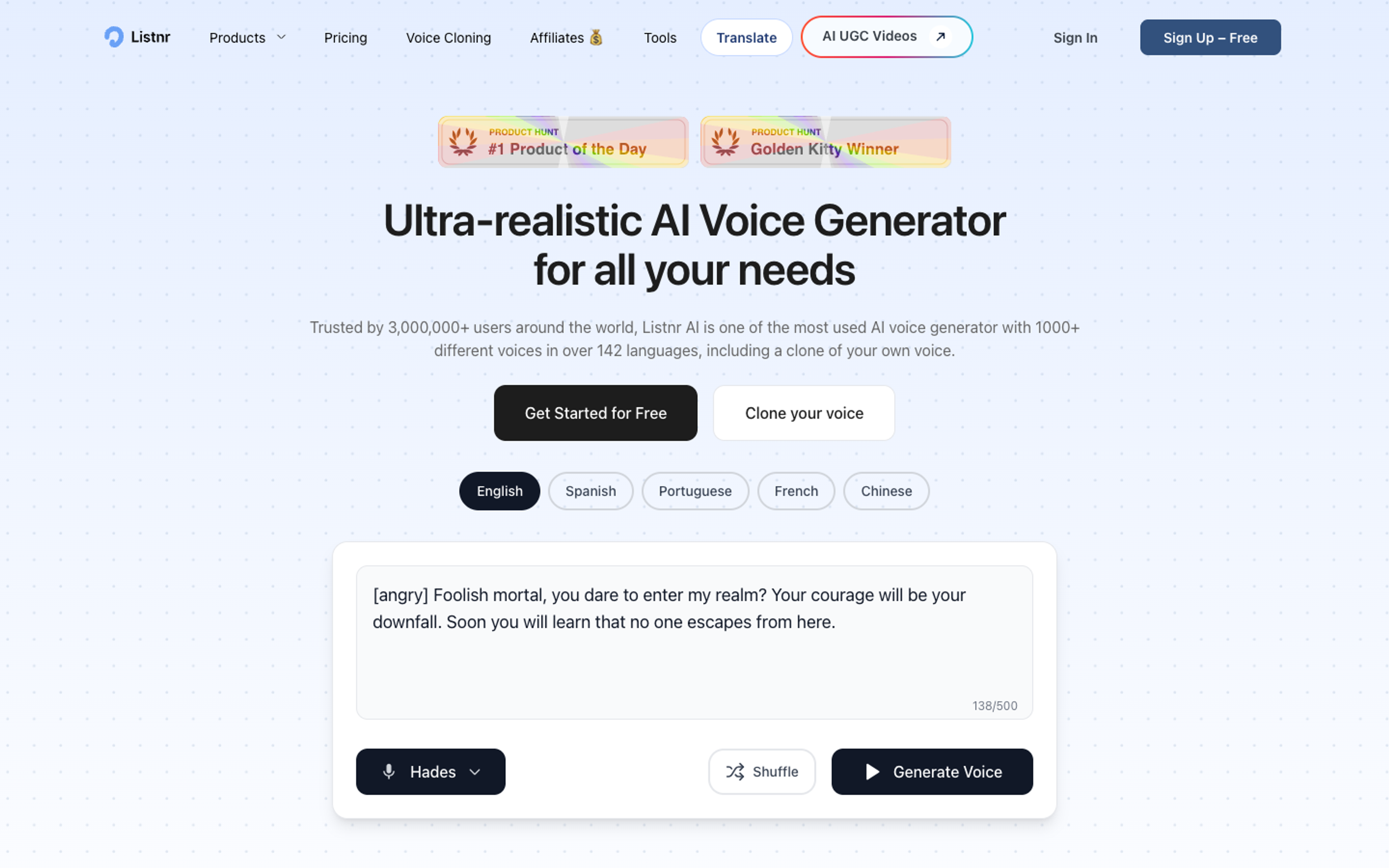
That combination matters more than it sounds. A lot of voice tools are strong in one direction and awkward in another. Some sound amazing but get expensive fast. Some are cheap but weak once you leave English. Some are fine for demos and annoying for real production. Listnr is not the absolute best at raw dramatic performance, but it is one of the best all-around buys if you need multilingual voiceovers, podcasts, YouTube narration, or localized content on a repeatable schedule.
Where it wins:
- Strong language coverage for global content
- Commercially usable output without weird licensing anxiety
- Straightforward plan structure
- Better fit than most for creators, agencies, and content teams that need to publish often
Where it falls short:
- If your only goal is the most expressive single-voice acting performance possible, ElevenLabs and Hume are stronger
- It is optimized for production practicality more than theatrical voice direction
Best for: creators, marketers, agencies, and teams that need one tool that can handle multilingual publishing without drama.
2. ElevenLabs
If I cared only about raw voice quality, ElevenLabs would be first. ElevenLabs still feels like the standard setter: 10,000+ voices, instant cloning, voice design, dialogue support, and speech in 70+ languages. Its pricing is also unusually transparent, with Starter at $5/month, instant voice cloning at that tier, and professional voice cloning higher up.
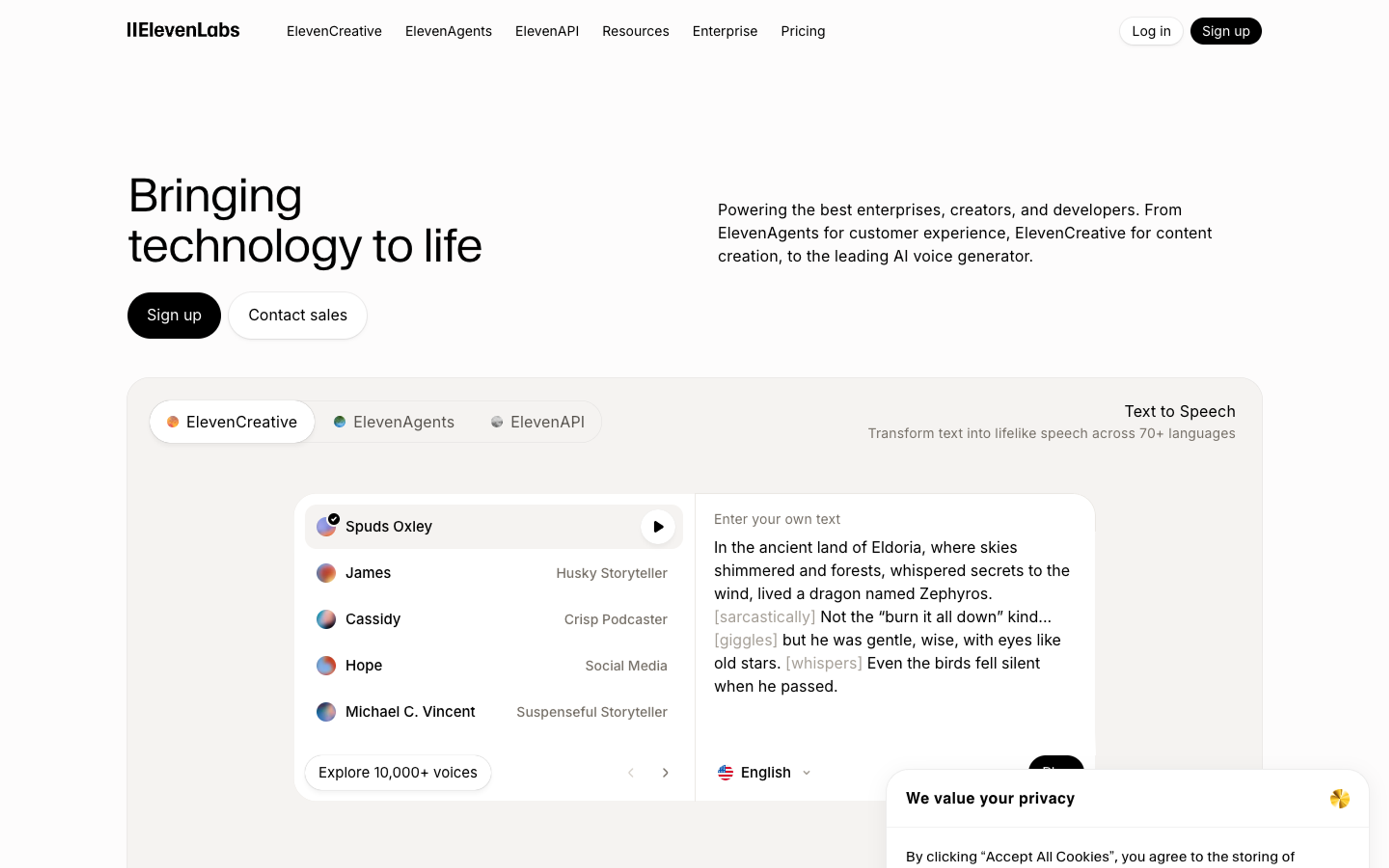
What ElevenLabs does better than almost anyone is make generated speech feel directed rather than merely read. It handles pauses, tone, pacing, and context better than most competitors, and that is why it keeps winning with audiobook teams, narrative voiceovers, character work, and premium branded audio.
The tradeoff is that ElevenLabs can become expensive once your usage gets serious, and it is easy to overbuy if you mostly need clean business narration rather than high-end expressive output. Still, if your north star is "make this sound human enough that people stop thinking about the tool," ElevenLabs remains the benchmark.
Best for: premium voiceovers, narration, cloning-heavy workflows, and teams that care more about output quality than plan simplicity.
3. Hume Octave
Hume Octave is the most interesting product in the category right now. Hume is clear about what makes Octave different: emotional intelligence, natural-language acting instructions, the ability to clone from a sample, and streaming output with about 300ms time to first byte.
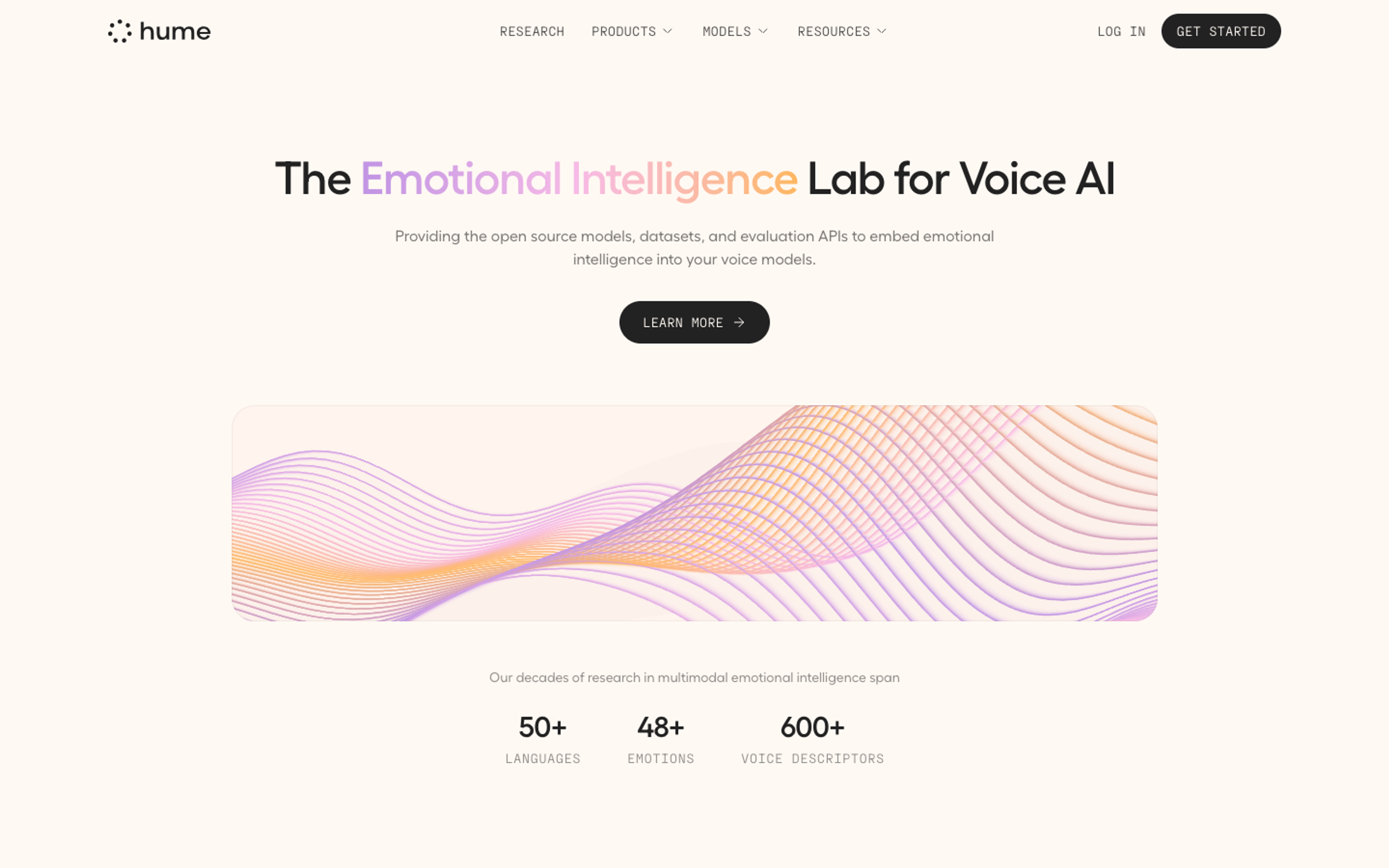
That sounds like marketing until you use tools in this class back to back. Most AI voice products let you choose a voice and maybe nudge the pacing. Hume wants you to direct performance. "Say this warmly." "Make this skeptical." "Slow it down and sound uncertain." That is a different level of control, and for anyone making ads, characters, guided experiences, or conversational products, it is a big deal.
Why it is third instead of first: the product is still more specialized than Listnr, and it rewards users who want to actively direct performance. If you just want fast, reliable, neutral narration, you may not need what Hume does best. But if emotional delivery matters, very few tools are as compelling in 2026.
Best for: expressive brand voice, conversational products, premium ads, and teams that want to direct delivery instead of settling for generic reads.
4. Murf AI
Murf has become two things at once: a familiar business voiceover brand and a serious voice infrastructure player. Right now the sharper signal is Murf Falcon, which claims 55ms model inference, sub-130ms end-to-end latency, 150+ voices in 35 languages, and pricing from 1 cent per minute.
That shift matters. In 2025, Murf was often described as a polished studio for marketing and e-learning teams. In 2026, it is just as important to read Murf as a company building voice infrastructure for real-time applications and agent workflows. That makes it a better fit for businesses than for hobbyists.
Murf still earns a high rank because it sits in a useful middle ground: clean business-friendly UX, respectable voice quality, and increasingly credible real-time performance. It is not as expressive as Hume, and it does not have ElevenLabs' aura for premium cloning, but it is a strong choice when you want reliability, team adoption, and business use cases rather than creator flash.
Best for: e-learning, product explainers, business voiceovers, and companies building voice features that need both polish and speed.
5. LOVO AI
LOVO stays in the list because it understands the creator bundle better than most pure TTS companies. LOVO currently highlights 500+ voices in 100+ languages, five voice clones on Basic, auto subtitles, unlimited downloads, and commercial rights. That is a practical set of features for creators who do not want to stitch together five different tools.
LOVO is not the best product here at any one thing. It is not the most expressive, not the cheapest for heavy usage, and not the fastest for real-time systems. But it is one of the easiest platforms to live inside if you make regular marketing content, short-form video voiceovers, or multilingual creator assets.
That is why it ranks ahead of a few technically stronger products. Workflow matters. If a tool is a little worse in one dimension but much easier to actually use every day, it often wins in practice.
Best for: creator teams, marketers, and people who want a broader content suite around voice generation.
6. WellSaid Labs
WellSaid still has a real place in this category because it is opinionated in a useful way. WellSaid makes the product philosophy obvious: you are working with curated voice avatars and filtering toward the right one, not wandering through a giant marketplace.
That makes WellSaid less exciting on paper and more effective in certain real workflows. For corporate training, internal comms, onboarding videos, and explainers, consistency often matters more than novelty. You want a voice that sounds trustworthy, clean, and stable across dozens or hundreds of assets. WellSaid is built for that.
The reason it does not rank higher is simple: it is less flexible for creators and less obviously priced for self-serve buyers than the top tools on this list. But if your company produces training content every month and wants a safe, polished studio feel, WellSaid is still a strong pick.
Best for: e-learning, internal enablement, training libraries, and teams that value consistency over experimentation.
7. Descript Overdub
Descript belongs on this list even though it is not a classic standalone voice generator. Overdub is still one of the smartest workflow products in audio because it turns voice generation into an editing feature. You do not just generate speech from scratch. You fix spoken content by editing text.
That distinction matters a lot. If you make podcasts, YouTube videos, talking-head explainers, or interview-led content, your real problem is often not "I need a synthetic narrator." It is "I need to fix a sentence without re-recording the entire thing." Descript is built for exactly that.
Descript starts at $16 per person per month on annual billing, and even lower tiers now include AI speech with custom voice clones. That makes it a strong buy for creator workflows where recording and editing live together.
Best for: podcasters, video creators, editors, and teams that want voice generation inside an edit-first workflow.
8. Cartesia
Cartesia is the clearest example of where the market is going. Cartesia is explicit about the bet: this is a voice AI platform built for scale, agents, and low latency. The company is leaning hard into time-to-first-audio, concurrency, and production-grade agent infrastructure, not just pretty demo voices.
This is not the tool I would hand to a solo YouTuber first. But if you are building a real-time voice product, Cartesia deserves to be on your shortlist. Its public pricing is also refreshingly clear for a developer-first company: free tier, Pro at $4/month billed yearly, Startup at $39/month billed yearly, then higher plans for scale.
Cartesia ranks below Descript because this list is about voice generators broadly, not just agent stacks. But for voice applications where latency is the whole game, Cartesia is one of the most relevant names in 2026.
Best for: voice agents, live interactions, support bots, and teams optimizing for latency first.
9. Resemble AI
Resemble remains one of the more enterprise-native products in the category. Resemble emphasizes voice cloning, speech-to-speech, rapid voice cloning from short samples, and roughly 200ms response times. It also talks more openly than many competitors about safety and the risks around synthetic voice misuse.
That makes Resemble a good fit for companies where voice is part of a larger product system, not just a creative export. If you need API flexibility, custom voices, and more governance around how those voices are used, Resemble feels like a serious option.
It ranks ninth because the top tools are more compelling for most creators and small teams. But if you are building something productized, especially with custom voice behavior and safety constraints, Resemble is stronger than many prettier creator tools.
Best for: enterprise products, custom voice systems, and teams that need API depth plus safety posture.
10. Synthesia
Synthesia makes the list because voice generation is often inseparable from the video workflow that follows it. Synthesia starts at $29/month, and its dubbing docs show how deep the multilingual video use case has become.
If your real output is training video, sales enablement, product walkthroughs, or localized explainers, a pure TTS tool can be the wrong layer to optimize. Synthesia is weaker than the leaders here if you judge only raw standalone voice generation. But if the voice is just one part of a larger video production system, it becomes a very efficient choice.
That is why it sneaks into the top 10. Sometimes the best voice generator is the one that removes an entire extra step from the workflow.
Best for: training videos, AI presenters, localization, and teams that publish video at scale.
What actually matters when choosing an AI voice generator
Most buyers focus on the wrong thing first. They listen to one demo clip, hear something realistic, and stop there. That is how you end up with a tool that sounds great in the browser and becomes annoying in production.
These are the filters that matter more:
- Voice realism: not just whether the sample sounds human, but whether it stays believable across longer scripts
- Direction control: can you shape tone, pacing, pauses, emphasis, and pronunciation without fighting the tool
- Language quality: a lot of platforms claim multilingual support; far fewer sound natural across languages and accents
- Workflow fit: do you need pure TTS, editing inside a video workflow, or a real-time agent stack
- Rights and consent: voice cloning without clear rules is a liability, not a feature
- Price under actual usage: a cheap entry plan means very little if the product gets expensive at scale
If you are a creator, workflow and pricing usually matter more than tiny gains in quality. If you are a product team, latency and API reliability matter more. If you are a brand team, voice control and rights matter more.
What changed from the 2025 list
Two obvious changes stand out.
First, older list staples are no longer reliable picks. Play.ht now shows a shutdown notice. Replica Studios has effectively turned into a farewell page. A 2026 article that still ranks them as active top choices is not doing its job.
Second, the center of gravity moved. The best products are not just "text in, audio out" tools anymore. They are separating into three camps:
- all-around creator platforms like Listnr and LOVO
- premium voice quality products like ElevenLabs and Hume
- infrastructure-first voice stacks like Murf Falcon, Cartesia, and Resemble
That is a healthier way to think about the market than pretending one checklist fits everyone.
FAQs
Which AI voice generator sounds the most human in 2026?
If your standard is pure realism and expressive delivery, ElevenLabs is still the safest answer. Hume is the more interesting challenger if you care about emotional direction and not just clean narration. Listnr is the better overall value if you need strong quality plus multilingual production and a more practical publishing workflow.
Which AI voice generator is best for YouTube and faceless channels?
For most YouTube creators, Listnr is the best balance of price, language coverage, commercial usability, and production speed. LOVO is also strong if you want a broader creator suite. If your channel lives or dies on dramatic narration quality, ElevenLabs is worth the extra spend.
Which AI voice generator is best for real-time AI agents?
Cartesia, Murf Falcon, Hume, and Resemble are the most relevant names if you are building live voice systems. Cartesia is especially compelling when latency is the headline requirement. Hume is stronger when emotional control matters. Murf Falcon is appealing when you want business credibility plus speed. Resemble is good when API flexibility and safety posture are part of the buying criteria.
Which tool is best for e-learning and corporate training?
WellSaid Labs and Murf are the two strongest fits for that use case. WellSaid is better if you want consistency, clean voice avatars, and a stable narration tone across a large training library. Murf is stronger if your team also wants broader platform depth or real-time voice infrastructure.
Why are Play.ht and Replica Studios not in this year's ranking?
Because a current ranking should reflect the current market. Play.ht now shows a shutdown message, and Replica Studios' site has become a farewell page. Keeping them in a 2026 "best tools" list would be lazy and misleading.
Final verdict
If you want the best all-around AI voice generator in 2026, pick Listnr. If you want the best pure voice quality, pick ElevenLabs. If you want the most expressive direction control, look hard at Hume. If you are building real-time voice products, move toward Cartesia, Murf Falcon, or Resemble instead of forcing a creator tool into a systems job.
That is the real story of the market this year. The best AI voice generator is not a universal winner. It is the tool that best fits the kind of audio work you actually ship.
Frequently asked questions
What should readers look for before choosing 10 Best AI Voice Generators in 2026?
The best AI voice generators in 2026 are not all chasing the same thing. Some are built for raw voice quality, some for multilingual publishing, some for low-latency voice agents, and some for fixing audio inside a video workflow. If you j…
How does Listnr fit into the decision for 10 Best AI Voice Generators in 2026?
Listnr is strongest for teams that need realistic AI voices, multilingual narration, and a practical workflow for turning written content into polished audio.
Sources
elevenlabs.io · Referenced during the refresh workflow.
hume.ai · Referenced during the refresh workflow.
cartesia.ai · Referenced during the refresh workflow.
murf.ai · Referenced during the refresh workflow.
listnr.ai · Referenced during the refresh workflow.

About Ananay Batra
Founder and CEO @ Listnr Inc
Ananay is the Founder & CEO of Listnr AI, he started Listnr with $100 in the bank back in 2020 and scaled it to 3.5m users across 200 countries and $1.2m in revenue.
https://ananay.ai/